Anthropic's official skills: all 19 in anthropics/skills, their license and what they cost
The anthropics/skills repository is Anthropic's official collection of skills for Claude: 19 folders of instructions, scripts and templates that teach Claude to design websites, build MCP servers, test apps with Playwright, or work with Word, Excel, PowerPoint and PDF files. They are the same skills Claude.ai uses under the hood to create files.
We read the whole repository (commit ca45fc4, October 28, 2026, rechecked against 2c5958e from November 6) to answer three practical questions: what each skill does, which ones you can copy and modify without legal trouble, and what using them costs you. Short version: the skills are free, 18 of the 19 are now open source, and two of them load into almost every conversation if you install them without thinking.
If you are new to skills, start with our Claude Code skills guide and come back.
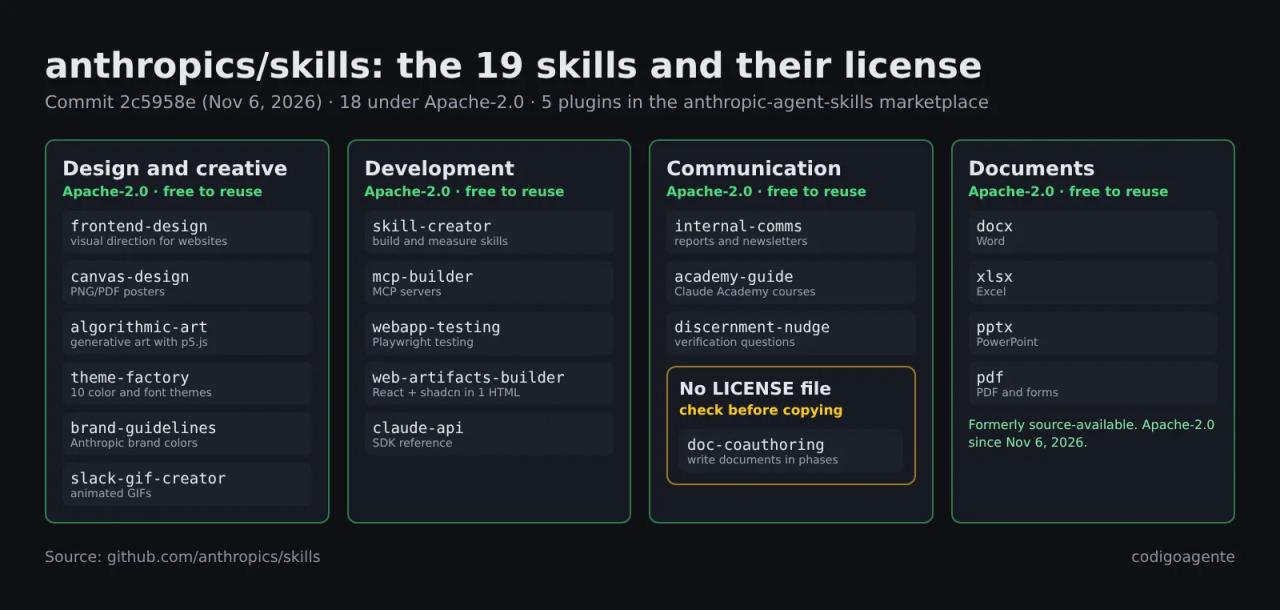
What the anthropics/skills repository is
Each skill is a folder with a SKILL.md file: a YAML header with name and description, followed by the instructions Claude follows when the skill is active. Some also ship Python or Bash scripts, templates and reference docs. The repository also includes:
template/SKILL.md: the minimal template for your own skill.spec/: a link to the open Agent Skills specification, the standard also followed by Codex, OpenCode, Cursor and Gemini CLI..claude-plugin/marketplace.json: turns the repo into a Claude Code plugin marketplace calledanthropic-agent-skills.
The README is clear: these skills are examples for demonstration and educational purposes. What Claude does in Claude.ai may differ from what you see here, so test them before relying on them for anything critical.
The 19 skills, one by one
Design and creative
| Skill | What it does | Needs |
|---|---|---|
| `frontend-design` | Art direction for websites: typography, palette and layout that don't look templated. Lists the AI-generated design tells to avoid. | Nothing |
| `canvas-design` | Posters and static pieces in PNG or PDF from a "design philosophy". Ships a fonts folder. | Python |
| `algorithmic-art` | Generative art with p5.js, seeded randomness and interactive parameters. | Browser |
| `theme-factory` | 10 color and font themes (Ocean Depths, Midnight Galaxy...) to apply to slides, docs or landing pages. | Nothing |
| `brand-guidelines` | Applies Anthropic's brand colors and typography. A good model for writing one for your own brand. | Nothing |
| `slack-gif-creator` | Animated GIFs within Slack's size limits. | Pillow, imageio, numpy |
frontend-design is the most useful of the group if you build websites. We put it to work in building a landing page with 4 skills, and it is the starting point of Impeccable.
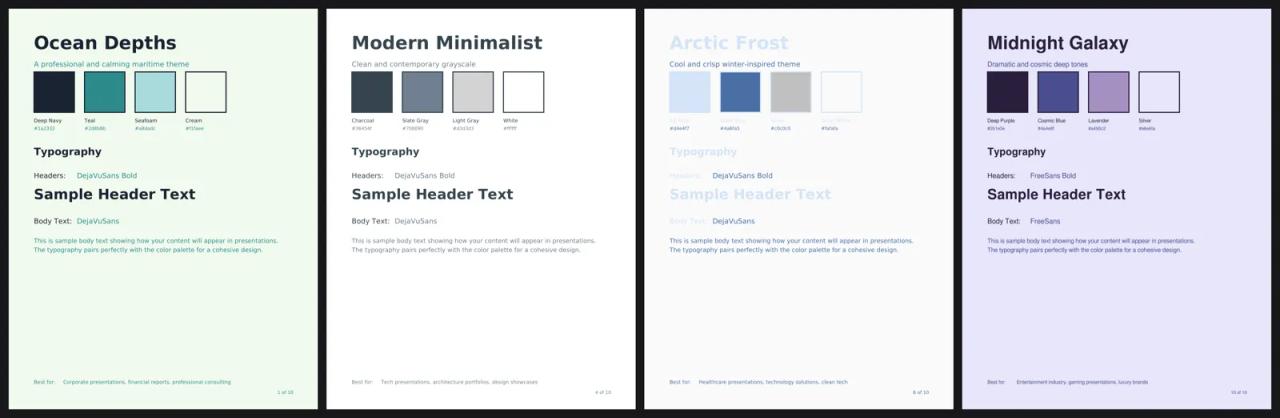
One detail we noticed in the sample PDF: the Arctic Frost theme sets the title in ice blue (#d4e4f7) on an almost white background, and it is barely readable. If you use it, switch headings to the steel blue from the same palette (#4a6fa5).
Development
| Skill | What it does | Needs |
|---|---|---|
| `skill-creator` | Creates new skills and improves them with a test loop: runs test prompts, compares results and tunes the `description` so the skill triggers when it should. | Python and the `claude` CLI |
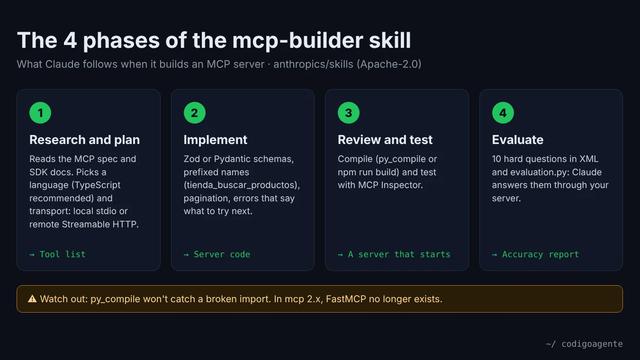
| `mcp-builder` | A 4-phase guide to building MCP servers in Python (FastMCP) or TypeScript, including v2 of the TypeScript SDK. Ends with 10 evaluation questions. | Python or Node |
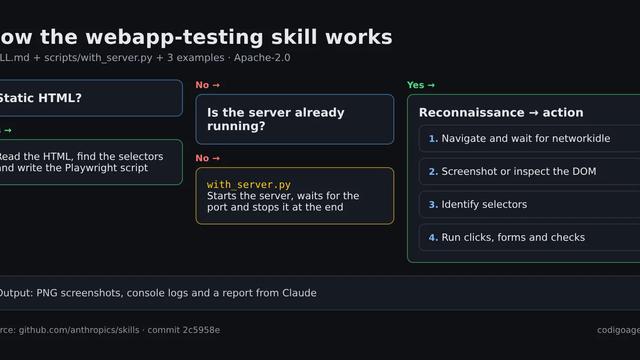
| `webapp-testing` | Tests your local web app with Python Playwright scripts: screenshots, console logs, clicks. `with_server.py` starts and stops your servers. | Python + Playwright |
| `web-artifacts-builder` | Builds Claude.ai artifacts with React 18, TypeScript, Tailwind and shadcn/ui, bundled into a single HTML file. | Node, Bash |
| `claude-api` | Anthropic SDK reference in 8 languages: models, pricing, streaming, tools, caching. | Nothing |
skill-creator is the hidden gem: if you sell or share skills, it lets you measure whether they actually improve results instead of trusting your gut. Note that its evals run claude -p several times, and every run uses tokens.
Communication
| Skill | What it does |
|---|---|
| `internal-comms` | Status reports, leadership updates, newsletters and FAQs in your company's formats. |
| `doc-coauthoring` | Writes documents (proposals, tech specs) in three stages: context gathering, section-by-section drafting and a final "reader test". |
| `academy-guide` | Recommends Claude Academy courses when you ask how to use Claude. |
| `discernment-nudge` | Appends 2-3 questions after an answer so you can check facts and assumptions. |
Documents: Word, Excel, PowerPoint and PDF
The docx, xlsx, pptx and pdf skills are what Claude.ai uses in production to create and edit files. They are the most polished in the repo, with scripts to fill PDF forms, recalculate Excel formulas or validate a .docx file's XML. Several need LibreOffice and pandoc installed to convert and check files.
Until November 6, 2026 they also had a different license, which brings us to the important part.
The license: Apache-2.0 for 18 of 19 skills
The repository has no global license. Each skill ships its own LICENSE.txt:
- 18 skills under Apache-2.0: you can use, copy, modify and redistribute them, commercially too, as long as you keep the license notice and mark your changes. In practice it is as permissive as MIT, plus a patent clause.
- The 4 document skills (
docx,xlsx,pptx,pdf) moved to Apache-2.0 on November 6, 2026 (commit2c5958e). Before that they were source-available: usable with Claude, but their license forbade copying, modifying or redistributing them. If you downloaded a copy before that date, keep the license it shipped with or update it from the repo. - 1 skill with no license file (
doc-coauthoring): with no explicit license, the default is "all rights reserved". Use it with Claude, but don't copy it into a public repo or resell it until Anthropic clarifies.
THIRD_PARTY_NOTICES.md also lists the third-party software bundled with the skills: imageio (BSD-2), FFmpeg (GPL-3.0), Pillow (HPND) and the canvas-design fonts (SIL Open Font License).
In practice: if you want to start from an official skill to build your own, for example a brand-guidelines with your client's colors, pick any of the 18 Apache-2.0 skills, now including the document ones.
How to install Anthropic's skills in Claude Code
There are two ways. Both are free.
Option 1: as a plugin from the marketplace
Inside Claude Code:
/plugin marketplace add anthropics/skills
/plugin install example-skills@anthropic-agent-skills
The marketplace offers 5 plugins:
| Plugin | Skills included |
|---|---|
| `document-skills` | docx, xlsx, pptx, pdf |
| `example-skills` | the 12 design, development and communication skills (not claude-api, academy-guide or discernment-nudge) |
| `claude-api` | claude-api |
| `academy-guide` | academy-guide |
| `discernment-nudge` | discernment-nudge |
Then just ask: *"Use the PDF skill to extract the form fields from contract.pdf"*.
Option 2: only the skills you need
The example-skills plugin installs 12 skills at once. If you only want one, the skills CLI lets you pick:
npx skills add anthropics/skills --skill frontend-design --agent claude-code -yChange --agent to codex, opencode or another compatible agent to install it there. This is the option we recommend, for a cost reason explained below. To browse other catalogs before installing, find-skills searches skills for you.
What Anthropic's skills cost
The skills cost nothing: they are text files in a public repository. What you pay for is the model that runs them.
| How you use them | Cost | Who it's for |
|---|---|---|
| Claude.ai (web and apps) | Included in paid plans, from Pro (20 USD/month, or 17 USD/month billed yearly) | Non-developers: Word, Excel, PowerPoint and PDF from the chat |
| Claude Code with a subscription | Pro 20 USD/month; Max 100 or 200 USD/month for daily use | Developers who use Claude Code often |
| Claude Code or the API, pay as you go | Per token. Our 4-skill landing page cost 1.58 USD at list price with Sonnet | Occasional use or automations |
| Another agent (Codex, OpenCode, Gemini CLI) | Whatever that agent costs; some have a free tier | Trying the 18 Apache-2.0 skills without paying for Claude |
What almost nobody mentions is how many tokens installed skills use:
- Descriptions always load. Claude reads the
nameanddescriptionof every installed skill at the start of each session to know when to trigger it. The 19 descriptions add up to about 9,500 characters (about 2,400 tokens) in every conversation, whether you use them or not. - The body only loads when used. The sizes vary wildly:
internal-commsis 1,500 characters;claude-apiis over 105,000 (about 26,000 tokens) in itsSKILL.mdalone, not counting its per-language folders. - Two skills trigger almost always.
academy-guideasks to be checked "before finishing any reply" about how to use Claude, anddiscernment-nudgeafter any substantive answer. If you pay per token, skip them unless you really want them.
Our recommendation to spend the least: use npx skills add to install only the 2 or 3 skills you will use (for example frontend-design and webapp-testing), and keep claude-api for projects where you actually code against the Claude API.
Common mistakes
The skill doesn't trigger. Claude decides based on the description. Name it in your prompt ("use the webapp-testing skill") or invoke it with /name.
webapp-testing fails to launch the browser. Its scripts use Playwright for Python, which the skill assumes is installed. Install it with pip install playwright and download the browser with playwright install chromium.
The document skills don't convert files. docx, pptx and xlsx use LibreOffice (soffice) to convert to PDF and recalculate formulas. Install it and make sure soffice is on your PATH.
skill-creator eats your budget. Each eval round runs claude -p several times. Start with 2 or 3 test prompts, not 20.
Copying a skill without checking its license. The document skills are Apache-2.0 now, but doc-coauthoring still has no license file: don't copy it into a public repo.
FAQ
Are Anthropic's skills free?
Yes. Downloading and installing them costs nothing. You pay for model usage: a Claude subscription or API tokens.
Are they open source?
18 of the 19 are (Apache-2.0). The four document skills have been since November 6, 2026; only doc-coauthoring still has no license.
Do they work outside Claude?
They follow the open Agent Skills standard, so Codex, OpenCode or Gemini CLI can read the SKILL.md. The scripts work the same if you have Python or Node. We have only used them in Claude Code.
Are they safe?
They come from Anthropic and the code is public, but the scripts run on your machine. For third-party skills, scan them first with SkillSpector.
Can I sell a skill based on one of Anthropic's?
If it starts from an Apache-2.0 skill, yes: keep the license and copyright notice and state what you changed. Since November 6 that includes docx, xlsx, pptx and pdf. If it starts from doc-coauthoring, no.
Conclusion
anthropics/skills is the best starting point to learn how a serious skill is written: there are short examples (internal-comms, 32 lines) and long ones with scripts and evals (skill-creator, mcp-builder). For everyday work, the best value comes from frontend-design if you build websites, webapp-testing if you test your apps and skill-creator if you write your own skills. Install them one at a time, check the license before copying anything, and leave out the ones that trigger on every reply.
Next step: use template/SKILL.md and skill-creator to turn that procedure you repeat every week into a skill.
// source code
// implementation
More on AI agents
- Skills for your agents
- Claude Code
- Skills for your agents
- Claude Code
- Skills for your agents
- Claude Code