Grill me in practice: 4 real examples, from moving a SaaS to preparing a talk
In the previous part we explained how grill-me works inside and tested it in a full four-round session. Here are real grill-me examples in different situations: an infrastructure decision, a talk, a digital product launch and a change inside a repository with code. Every session ran in Claude Code 2.1.316 with Sonnet 5.5 and the mattpocock-skills 1.3.2 plugin. The prompts were written in Spanish; we translate them here.
For each example you'll see the exact prompt, what the agent asked, what it really added, and what to watch out for.
How to write the opening prompt
grill-me works with any text, but the quality of the first round depends on three things you should always give:
- What you want to do, in one sentence.
- The context the agent can't guess: country, size, budget, stack.
- Why you want it, if the reason isn't obvious.
The template we used in all four examples:
/mattpocock-skills:grill-me <what I want to do> <with what and in what context> <what for, or why>Example 1: moving a SaaS from Vercel to a VPS
A typical infrastructure decision, where the real risk isn't in the code.
/mattpocock-skills:grill-me I'm thinking of moving my invoicing SaaS (Next.js + Postgres, about 120 paying customers) off Vercel and Neon onto my own VPS with Coolify to save about 150 USD a month.The first round had six questions and none was about Coolify or Docker. All of them went after the premise:
- The real motive. 150 USD a month is 1,800 a year; a few hours of operations a year (patches, backups, incidents) wipe out the saving. Is it only money, or also control or a specific limit?
- Which part of the bill disappears. If Neon explains most of it, moving just the database gets most of the saving with less risk.
- Tolerable data loss and downtime (RPO and RTO). With accounting data, it recommended at most 5 minutes of lost data via continuous WAL archiving (pgBackRest or WAL-G to S3/R2), which Coolify's default nightly backup doesn't give you.
- Legal obligations, a single point of failure and who's on call at 3 a.m.
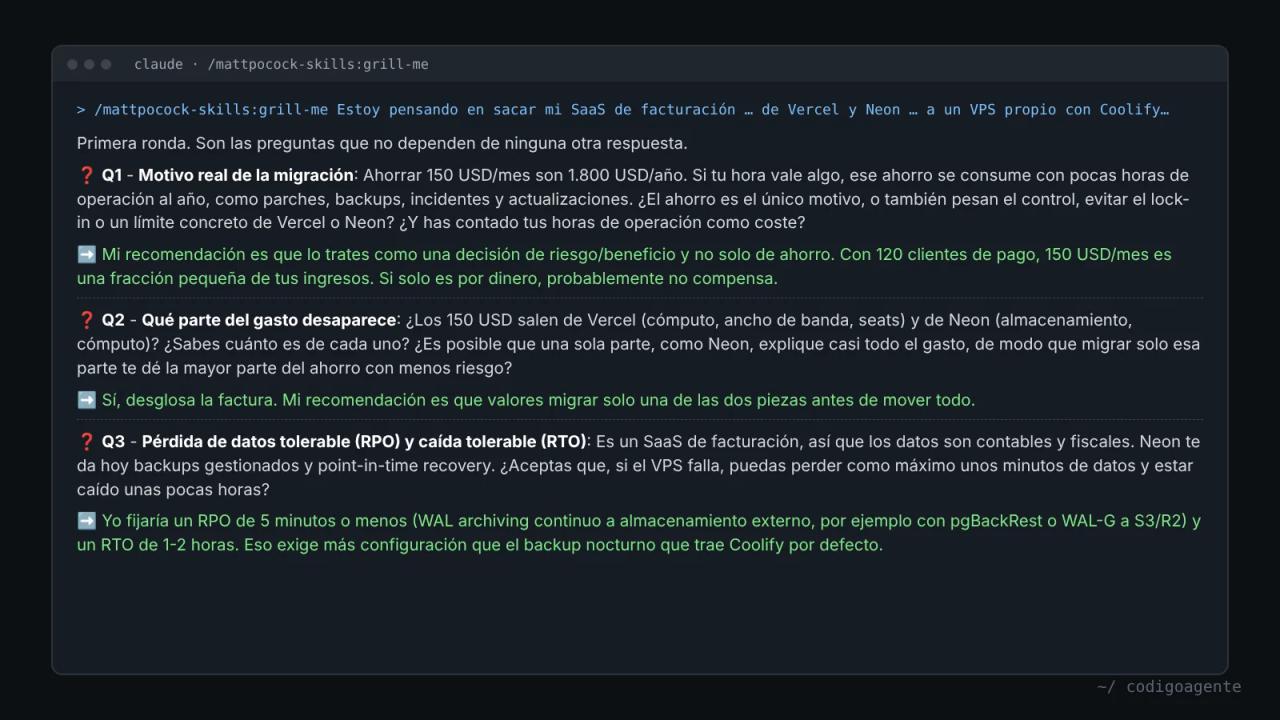
What it added: it turned "save 150 USD" into a risk decision, with a cheaper alternative (move only one piece) that wasn't in the plan.
Watch out for: on the legal question it assumed GDPR and EU servers. The prompt didn't name a country, so the agent filled in a European context. Always say where you operate.
If you do decide to move, the blog has a hands-on guide to installing an app on a VPS with Coolify.
Example 2: preparing a 20-minute talk
A case with no code and no repository, exactly the use the author recommends grill-me for.
/mattpocock-skills:grill-me I have to give a 20-minute talk to small business owners in Quito about using AI agents in their business. My idea: 5 minutes on what an agent is, 10 minutes of live demos with WhatsApp and invoices, 5 minutes of Q&A.Eight questions in round one, reading like a good event organiser's checklist:
- The goal: what should happen afterwards? It recommended that every attendee leaves with one concrete action for that week, plus a QR code to contact you.
- The audience: shop and service owners who use WhatsApp every day but have barely used AI beyond ChatGPT.
- The core pain: answering WhatsApp at all hours, and Ecuador's electronic invoicing (SRI).
- Explaining "agent" without jargon: a new-employee analogy and a single "chatbot vs. agent" slide.
- Live demos with a plan B: your own hotspot and backup videos open, because "in a venue in Quito, wifi is a real risk".
- Fake data, realistic timings (4 minutes per demo plus 2 of buffer) and written questions from minute 15.
What it added: the timing fix and the demo plan B are the two failures that ruin most talks, and both came up in round one. It also flagged what came next: the close, handouts and SRI data security.
Watch out for: nothing notable. With local context in the prompt (Quito, small businesses, SRI) the recommendations were local.
Example 3: launching an ebook on Hotmart
A business decision, with numbers involved.
/mattpocock-skills:grill-me I want to launch a 19 USD ebook on building an e-commerce store with AI, sell it on Hotmart and promote it only through my blog and Facebook.Six questions, ordered from most to least constraining:
- The exact buyer: a total beginner, someone already dropshipping, or a physical business going digital. It recommended picking one.
- The concrete promise: "how to build an e-commerce store with AI" is a topic, not an outcome. It suggested something measurable, like "your online store live in 7 days with AI".
- Your real case: without your own store with screenshots and numbers, the ebook competes on price alone.
- Your current traffic, flagged as a fact only you know. With a reference conversion of 1-3%, 50 sales need 2,000-5,000 visits to the sales page.
- What success means and by when: 100 sales in 90 days, with a review at day 30.
- Available time and budget.
What it added: the traffic question, which can sink a "blog and Facebook only" plan before you write a page.
Watch out for: the agent quoted Hotmart's fee from memory (9.9% + 0.49 USD per sale) and a "reference" conversion rate. grill-me tells it to find facts itself, but with no web tools and no code to read, it fills them in from what it remembers. Check every figure before deciding on it.
Example 4: a change inside a repository
When there's code, the agent can resolve facts on its own. For this example we built a minimal repository for a bike repair shop: a Turno type, a crearReserva function, a cancelarCita function and an Orden type pointing at turnoId (three Spanish words for "appointment": turno, reserva and cita). We ran the docs variant, which runs the same interview:
/mattpocock-skills:grill-with-docs I want customers to be able to reschedule their appointment from a link in the WhatsApp confirmation, without calling the shop.Before asking anything, the agent read the code and reported what it found:
- No
GLOSSARY.mdand no ADRs. - Three words for the same thing: the type is
Turno, one function saysReserva, anotherCita, and the user says "cita". - Nothing about WhatsApp and no availability model.
cancelarCitachanged the status with no rules at all.
Its first question was about vocabulary: keep Cita as the single term and mark "Turno" and "Reserva" as aliases to avoid. The next ones came from the code itself: whether rescheduling changes the same appointment or creates a new one (an Orden points at the id, so creating a new one would break that link), which states can be rescheduled, how far in advance and how many times.
What it added: the questions were about *my* code, not generic. None asked for a fact that was in the repository.
Watch out for: with grill-with-docs the agent writes files. After round two it had already created a GLOSSARY.md; we look at it in detail in part 4 of the guide.
What repeats across the four examples
| Example | Round 1 questions | Round 1 cost | What it questioned first |
|---|---|---|---|
| Move to a VPS | 6 | 0.065 USD | The motive (is the saving worth it?) |
| Talk | 8 | 0.063 USD | The goal of the talk |
| Ebook | 6 | 0.062 USD | The buyer and the promise |
| Change in the repository | 7 | 0.092 USD | The code's vocabulary |
Three clear patterns:
- It starts with why. In the non-code cases, the first question always challenged the premise, not the execution.
- It previews the next round. Every round ended by naming the branches left for later. You see the whole tree even though you only answer the frontier.
- It fills in missing context. No country, so it assumed Europe. No data, so it used figures from memory. The more context you give up front, the less you'll correct.
What to do with the result
A grill-me session ends with a summary you confirm. From there:
- If it's a build, pass it to
/to-specto turn it into a spec on your issue tracker (covered in part 5). - If you need information from someone else, use
/to-questionnaireto send them a questionnaire. - If you continue in another tool or session,
/handoffsaves it as a portable document. - If it was a personal decision, copy the summary into your notes: it's the decision, already reasoned.
FAQ
How many rounds does it usually take? In our tests, 3 to 4 rounds for a medium-sized change. The newsletter in part 2 took 4 rounds and 20 questions.
Can I answer "I don't know"? Yes. If it's a decision, the agent proposes a default. If it's a fact, it will try to find it or mark it as pending.
Does it work for writing? Yes: an article, a script or a sales proposal work just like the talk in example 2.
Next step
Pick a decision you've been putting off for days and run /grill-me on it with the template above. In part 4 of the guide we move on to grill-with-docs and domain-modeling, the pair that turns every grilling session into a glossary and documented decisions inside your repository.
// source code
// implementation
More on AI agents
- Skills for your agents
- Claude Code
- Skills for your agents
- Claude Code
- Skills for your agents
- Claude Code